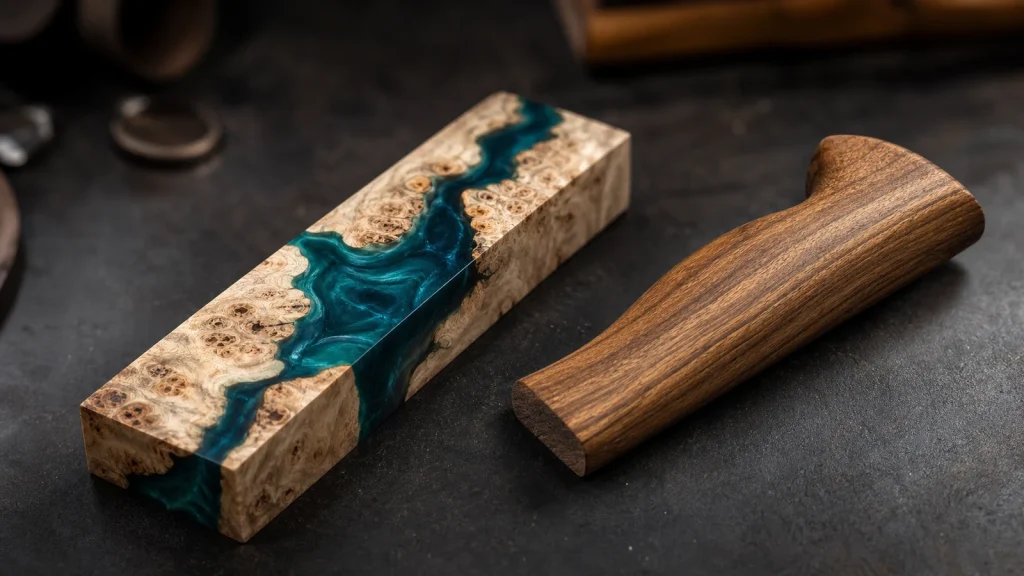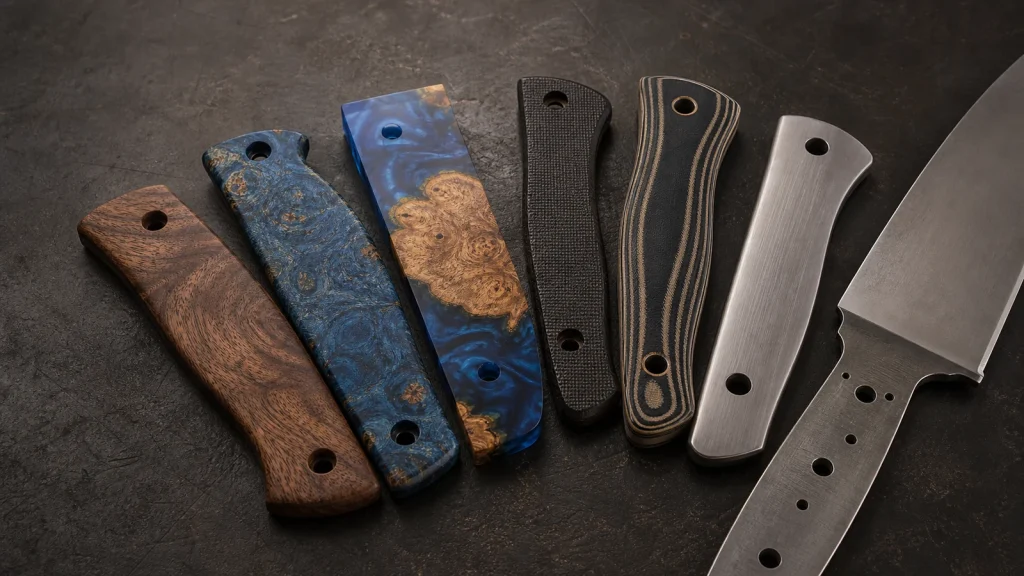
Choosing between stabilized wood vs natural wood is not simply a choice between and Stabilized wood offers greater consistency in demanding conditions, while a well-dried natural hardwood can provide an authentic feel and years of service. The right material depends on the wood species, the working environment, and the finish you want.
1. The Short Answer
For kitchen knife handles, the stabilized wood vs natural wood choice usually favors stabilized material because it responds less to moisture and repeated temperature changes. Natural wood remains a good option when it is dense, properly dried, accurately fitted, and cared for by hand. Neither material should be treated as dishwasher-safe.
2. What Is Natural Wood?
Natural wood handle material is seasoned wood that has not been impregnated with resin. Its appeal comes from the warmth, grain variation, and tactile character that remain distinctly natural. Dense hardwoods can polish beautifully and resist everyday wear, but wood still exchanges moisture with its surroundings. Poorly dried or unsuitable stock may shrink, swell, warp, or crack.
3. What Is Stabilized Wood?
Professional stabilization starts with dry wood. Air is removed from its open structure under vacuum, resin is introduced, and pressure helps move that resin into accessible pores. Heat then cures it into a solid. This is an internal treatment鈥攏ot merely a surface coating.
The process can add hardness, weight, and dimensional stability. It also makes many porous woods and highly figured burls more suitable for stabilized wood knife handles. Results still depend on the species and the quality of the treatment; resin cannot turn weak, wet, or badly cracked stock into flawless handle material.
4. Stabilized Wood vs Natural Wood Compared
| Factor | Stabilized Wood | Natural Wood |
|---|---|---|
| Moisture response | Lower movement in changing conditions | More dependent on species and finish |
| Hardness | Often harder and more wear-resistant | Varies widely by species |
| Weight | Usually heavier after resin treatment | Retains its original density |
| Feel | Smooth, dense, sometimes less organic | Warm and naturally textured |
| Appearance | Can support vivid colors and figured grain | Shows the wood in its original state |
| Maintenance | Generally lower | May need periodic conditioning |
| Best fit | Kitchens, humid climates, porous woods and burls | Dense hardwoods, traditional designs, careful users |
5. Does Every Knife Handle Wood Need Stabilizing?
No. Soft, porous, spalted, or burl wood often benefits most because resin supports fragile grain and improves consistency. Maple and buckeye burl are common examples where stabilization can make a substantial difference.
At the other end of the spectrum, some dense, naturally oily woods already resist moisture well and may accept resin poorly. Desert ironwood, African blackwood, cocobolo, and some rosewoods are often considered in this group. However, a species name alone is not a guarantee: each blank should be judged for dryness, soundness, grain orientation, and intended use.
6. Which Is Better for Kitchen Knife Handles?
Kitchen handles face wet hands, food residue, frequent wiping, and repeated changes in humidity. For a light or porous species, stabilized stock offers a useful margin of reliability. It is also a practical choice for brands that need more consistent machining and finishing across multiple handle sets.
A dense natural hardwood can still be an excellent kitchen handle material when it is properly seasoned and sealed. Its advantage is a more traditional look and feel; its trade-off is greater dependence on construction quality and owner care. Wash the handle by hand, dry it promptly, and never leave it soaking.
7. What to Check Before Buying Wood Scales
- Species and condition: Confirm the wood is sound and appropriate for the intended environment.
- Dryness: Stabilization should begin with properly dried stock.
- Treatment quality: Look for even penetration and ask how the material was processed.
- Defects: Inspect both faces and edges for checks, soft pockets, or large voids.
- Dimensions: Allow enough thickness for flattening, shaping, and final finishing.
- Batch consistency: For production orders, approve samples before committing to color and figure.
8. Final Choice
In the stabilized wood vs natural wood comparison, choose stabilized wood when moisture resistance, repeatability, or support for figured grain matters most. Choose natural wood when you value its original character and are working with a dense, well-seasoned species. The best handle begins with suitable stock and honest expectations鈥攏ot a label alone.
Still comparing options? Read our guide to knife handle materials, or contact World Backyard to discuss material requirements for your project.