Knife handle materials do more than complete the blade. They affect balance, grip security, comfort, maintenance, and the way the finished knife is perceived. A beautiful material can still be a poor choice if it becomes slippery, moves with humidity, or shifts too much weight behind the hand.
The best knife handle material is therefore not a single species or composite. It is the material that suits the knife, its working environment, and the person using it. This guide compares the most useful options and explains what makers and buyers should check before choosing a handle blank.
1. Start With the Knife’s Purpose
Material selection becomes easier when the intended use is clear:
- Kitchen knives need comfort, clean joints, moisture resistance, and balanced weight.
- Outdoor and hunting knives benefit from dependable traction, impact resistance, and stability in changing weather.
- Everyday-carry knives usually favor low weight, durability, and minimal maintenance.
- Collector and presentation knives can prioritize rare grain, color, and craftsmanship, provided the material matches the expected level of use.
Appearance matters, but it should come after practical requirements. A working handle must let the hand find a secure position without sharp transitions, pressure points, or excessive effort.
2. How to Compare Knife Handle Materials
Compare materials using five practical factors:
- Stability: Will it swell, shrink, warp, or crack as moisture and temperature change?
- Grip: Does the surface remain controllable when the hand is wet or oily?
- Weight: Will it support the intended balance rather than make the knife blade-heavy or handle-heavy?
- Workability: Can it be drilled, shaped, sanded, and finished without chipping or overheating?
- Care: Does it need regular oiling and careful storage, or only normal cleaning?
3. Best Wood for Knife Handles
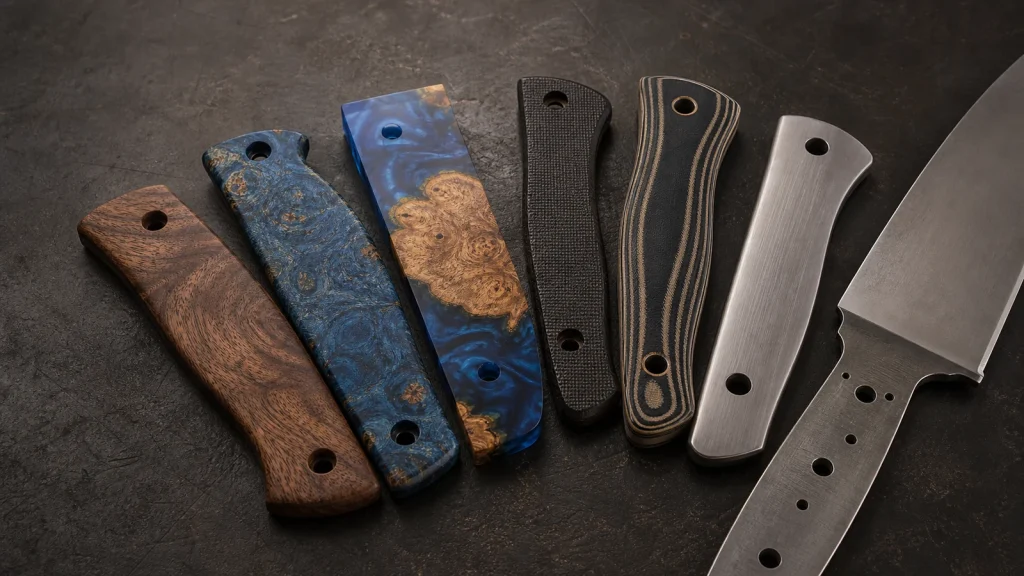
Natural wood remains popular because it feels warm in the hand and gives every knife a unique grain pattern. When choosing the best wood for knife handles, dense hardwoods such as walnut, ebony, rosewood, and desert ironwood are generally better suited than soft, open-grained species.
Its main limitation is movement. Untreated wood exchanges moisture with the surrounding air, so poor storage or repeated soaking can lead to raised grain, gaps, warping, or cracks. A properly dried blank, accurate fitting, and a suitable oil or sealed finish reduce these risks.
Best for: traditional kitchen knives, hunting knives, handmade pieces, and users who appreciate natural aging and do not mind basic maintenance.
4. Stabilized Wood Knife Handles
Stabilized wood knife handles begin with suitable dry wood that is infused with resin and cured. The process fills much of the porous structure, increasing density and reducing moisture movement while preserving the original grain. Figured burl is especially popular because stabilization makes delicate patterns more practical to machine and use.
Quality still varies. Resin penetration, curing, the condition of the original wood, and the absence of internal voids all matter. Stabilized wood is moisture-resistant, but it should not be described as indestructible or completely waterproof.
Best for: custom kitchen knives, premium outdoor knives, small-batch production, and handles that need natural character with more predictable dimensions.
5. Resin Knife Handle Blanks and Wood Hybrids
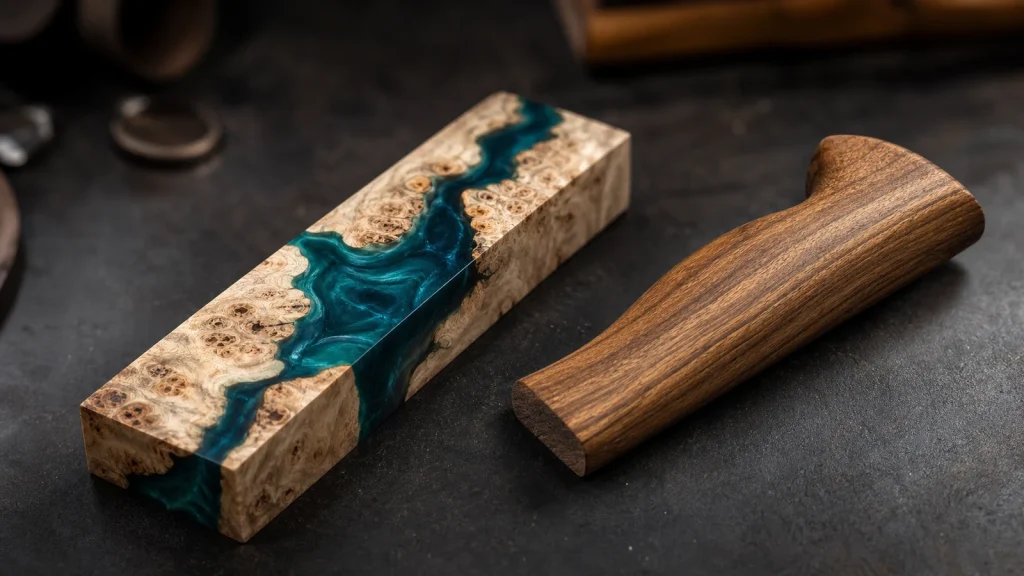
Resin knife handle blanks may use solid cast resin or combine wood, burl, and decorative inclusions with resin. They offer colors and patterns that natural timber cannot produce, from translucent sections to pearl effects and sharp two-material contrasts.
The interface between resin and wood deserves close inspection. A good blank should be fully cured and free from major bubbles, weak edges, or separation lines. Because resin and wood respond differently to grinding heat, makers should use sharp abrasives, moderate pressure, and controlled temperatures during shaping.
Best for: distinctive chef knives, custom projects, gift knives, and product lines that need repeatable color themes without losing the individuality of wood.
6. G-10 vs. Micarta Knife Handles
Micarta knife handles use layers of fabric or paper bonded with resin. They are tough, dimensionally stable, and comfortable when properly textured. Canvas-based versions can develop a more tactile surface, while finer laminates produce a cleaner appearance.
G-10 knife handle material uses fiberglass cloth in an epoxy-resin system. It is hard, light, non-porous, and well suited to aggressive machining patterns. Compared with Micarta, it often feels more technical and can provide sharper texture. Dust from either material should be controlled with suitable extraction and personal protection during machining; OSHA provides additional guidance on workshop dust hazards and controls.
Best for: wet environments, outdoor knives, tactical designs, EDC knives, and production models where consistency and low maintenance are priorities.
7. Metal Handles: Thin, Strong, and Design-Dependent
Stainless steel offers strength and corrosion resistance but adds noticeable weight. Aluminum is much lighter and accepts anodized finishes, although it can show dents and scratches. Titanium combines low weight, corrosion resistance, and premium appeal, but costs more to machine.
A smooth metal handle can be slippery and may feel cold, so contouring, milling, inlays, or added scales often determine whether it performs well. Metal is most useful when it forms part of the knife’s structure rather than being chosen for appearance alone.
8. Traditional and Decorative Materials
Bone, horn, antler, leather, shell, and other decorative materials can give a knife strong historical or collector character. They also bring additional considerations: natural variation, brittleness, moisture sensitivity, irregular dimensions, and—in some cases—legal or sourcing restrictions. Documentation and intended use should be confirmed before specifying uncommon animal-derived materials.
9. Knife Handle Material Comparison
This quick comparison shows how the main knife handle materials differ in everyday use:
| Material | Main Strength | Main Trade-Off | Good Fit |
|---|---|---|---|
| Natural wood | Warm feel and unique grain | Needs moisture control and care | Kitchen, hunting, traditional knives |
| Stabilized wood | Natural appearance with improved stability | Quality depends on processing | Premium kitchen and custom knives |
| Resin-wood hybrid | Distinctive color and pattern | Requires careful machining | Custom, gift, and statement knives |
| Micarta | Tough and comfortable | Less visually varied than hybrid materials | Outdoor, kitchen, and working knives |
| G-10 | Stable, light, and highly texturable | Harder, more technical feel | EDC, tactical, and wet-use knives |
| Metal | Strength and structural precision | Can feel cold or slippery | Folders and modern designs |
10. Construction Matters as Much as Material
An expensive blank cannot compensate for poor assembly. Full-tang scales need flat mating surfaces, accurate pin holes, even adhesive coverage, and sealed edges. Hidden-tang handles need a slot that matches the tang without leaving weak walls or oversized gaps. Pins, collars, guards, and liners should finish flush so they do not create hot spots or collect moisture.
When ordering knife handle scales and blanks, confirm the finished dimensions, tang type, slot size, pin layout, material tolerance, and required surface condition. For repeat production, also approve the acceptable range of color and grain variation before the full batch is made.
11. What Is the Best Knife Handle Material?
The best knife handle material depends on the intended use. Choose natural wood when tactile warmth and traditional character are central to the design. Select stabilized wood when you want similar visual depth with better dimensional control. Use resin-wood hybrids when color and individuality are the product’s signature. For demanding, low-maintenance working knives, Micarta or G-10 is usually the safer direction. Metal works best when weight, texture, and temperature feel have already been considered in the handle design.
When comparing knife handle materials, the right result comes from matching material, geometry, and construction—not from selecting the most expensive option.
12. Planning a Custom Knife Handle?
World Backyard supplies knife handle blanks and finished handle options for custom makers, kitchen-knife brands, and OEM projects. Browse our knife-making and kitchenware products, or contact us with your preferred material, dimensions, tang or slot requirements, finish, and estimated quantity.